
The food & beverage industry encompasses those companies that facilitate the production and manufacturing of various consumable food items. The ecosystem includes the facilities which transport, serve, or sell such edible products. This market consists of beverages & food manufacturing operations, catering, food joints, food transportation facilities, along with other closely related segments. Being a developing nation with a rapidly expanding population base, India is witnessing an escalating demand for food & beverages. As per market data, nearly 3% of India’s GDP is contributed by the food & beverages industry. The nation houses many food & beverage companies who have amplified their reach on a global level. The Indian Food & Beverage Industry is reckoned to garner substantial gains in the coming years due to the indicated presence of various growth inducing factors. Here is a quick overview of a few key players in the industry.
We, DART Analysts, based on data up to FY2022, had indicated that the Indian Food & Beverage sector achieved an industry CAGR of 11.7%, with strong contributions from companies such as Tata Consumer Products and Varun Beverages. At that time, we projected a 14% CAGR for 2023–2027, reflecting optimism driven by investments, organised retail expansion, and rising consumption. However, updated analysis using data up to FY2025 shows the sector growing at a lower pace — industry CAGR of 7.6%, reflecting a moderation in growth due to structural constraints and near-term headwinds.
This downward revision from 11.7% to 7.6% indicates a transition from an earlier high-growth expectation to a more moderate, structural-growth phase. While leading firms such as Tata Consumer Products and Varun Beverages continue to post healthy CAGRs (albeit lower than earlier estimates), several constraints have weighed on sector-wide momentum.
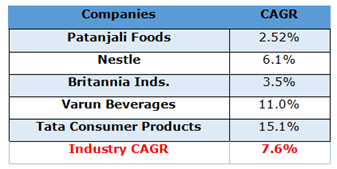
*Companies ranked based on FY2025 Revenue (highest – lowest)
The moderation in growth is primarily attributed to infrastructure and cold-chain limitations leading to 15–30% post-harvest losses, fragmented value chains and mandi dependence that restrict efficiency, and low capacity utilization affecting profitability. Additionally, regulatory complexities and input cost volatility across key commodities have constrained innovation and margin expansion. However, the sector retains strong structural drivers, including rising organised retail and e-commerce penetration, increasing global reach of Indian F&B brands, growing packaged food demand in both urban and rural markets, and supportive policies encouraging investment in processing and cold-chain infrastructure.
Given these structural constraints and assuming incremental improvements in infrastructure and policy execution, the F&B sector is expected to stabilize and grow at around 10% CAGR between 2026–2029. This outlook assumes: modest reduction in post-harvest losses through investment, improved cold-chain capacity, better capacity utilization, and steady consumer demand as inflation moderates.
Here is a quick overview of key players in the industry
Patanjali Foods Limited
Patanjali Foods Limited (formerly Ruchi Soya Industries) is one of India’s leading FMCG and edible oil companies, operating across categories such as packaged foods, nutraceuticals, and personal care. The company’s product portfolio includes cooking oils, soya-based foods, dairy products, biscuits, noodles, honey, and herbal supplements. As part of the Patanjali Group, it leverages a strong brand presence rooted in Ayurveda and natural wellness, catering to both urban and rural consumers. Patanjali Foods operates an extensive distribution network with pan-India reach and growing exports to international markets. The company is headquartered in Haridwar, Uttarakhand, India.
Varun Beverages Limited
Varun Beverages Limited (VBL) is one of the largest franchisees of PepsiCo beverages outside the United States. The company manufactures, bottles, and distributes a wide range of carbonated soft drinks, packaged drinking water, and non-carbonated beverages under PepsiCo’s brand portfolio, including Pepsi, Mountain Dew, Mirinda, Tropicana, and Aquafina. VBL operates an extensive production and distribution network across India and multiple international markets such as Africa and Nepal. The company continues to expand its capacity and diversify into value-added product categories such as juices and dairy-based drinks. Varun Beverages is headquartered in Gurugram, Haryana, India.
Britannia Industries Limited
Britannia Industries Limited is one of India’s leading food companies, best known for its wide range of bakery and dairy products. The company’s product portfolio includes biscuits, cakes, breads, rusks, dairy products, and snacks under popular brands such as Good Day, Marie Gold, NutriChoice, and Milk Bikis. With over a century of heritage, Britannia has a strong distribution network reaching both urban and rural markets and continues to innovate with health-focused and premium product variants. The company also exports to more than 80 countries. Britannia Industries is headquartered in Bengaluru, Karnataka, India.
Nestlé India Limited
Nestlé India Limited is a subsidiary of Nestlé S.A., one of the world’s largest food and beverage companies. It operates across diverse categories such as prepared dishes and cooking aids, dairy, confectionery, and beverages. Its key brands include Maggi, Nescafé, KitKat, Milkybar, Nestlé Everyday, and Cerelac. The company emphasizes nutrition, health, and wellness through continuous innovation and localized product development. Nestlé India operates multiple manufacturing facilities across India, supported by an extensive supply chain and a wide retail presence. The company is headquartered in Gurugram, Haryana, India.
Tata Consumer Products
Tata Consumer Products Ltd (TCPL) is a manufacturer and marketer of food products and non-alcoholic beverages, with a major focus on tea and coffee. The company markets tea and coffee products under Tata Tea, Vitax, Eight O’Clock Coffee, Tetley, Tata Coffee Grand and Joekels brand names. TCPL’s food products include spices, pulses, healthy snacks, breakfast cereals, salt, poha and ready to mixes under Tata Sampann, Tata Salt, and Tata Soulfull brands. The company’s business operations span across Asia-Pacific, Europe, the Middle East, Africa, and North America. TCPL is headquartered in Mumbai, Maharashtra, India.
Industry Performance
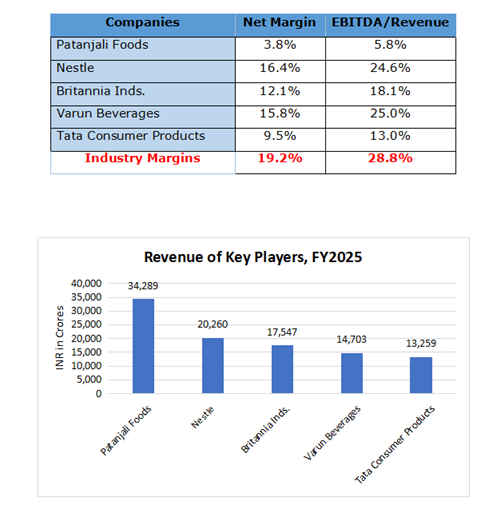
The performances of key companies in the industry give indications that the industry has been reporting steady profits quite for a long time. The reported margin of the key players was around 10.6% by taking into consideration of the last 3 years data. Details are as follows.
Industry Trends
Food & beverages are considered as the fastest growing industries in India. The growth of the industry is supported by the availability of a large raw material production base. With India’s population skewed towards younger consumers, the majority of Indian consumption of food and beverages is driven by people between the ages of 18 and 40, which opens the opportunity for manufacturers to come with more varieties. Some of the major growth drivers of this industry are:
- Demand shift to convenience and value-added foods
Urban lifestyles and limited time are driving demand for packaged, RTE/RTC, frozen, and value-added products. Expansion of cold-chain and Mega Food Parks under PMKSY is boosting supply and market penetration beyond metros.
- Health, wellness, and specialty/organic expansion
Rising health awareness and millet promotion policies are fueling demand for fortified, organic, and functional foods. Consumers are willing to pay premiums for clean-label, specialty SKUs, driving rapid innovation and growth.
- Infrastructure scale-up and formalization
Government schemes like PMKSY and PMFME are expanding food processing and preservation infrastructure. New Mega Food Parks, cold chains, and agro clusters are strengthening logistics and reducing post-harvest losses.
- Investment momentum and FDI inflows
Steady FDI and rising capex are modernizing India’s food processing sector, with automation and machinery upgrades underway. Investments span beverages, dairy, and snacks, focusing on efficiency and sustainable packaging.
- Export orientation and global integration
Processed foods now form a growing share of India’s agri-exports, supported by brand-building initiatives and value-added products. The industry is projected to reach US$700 billion by 2030 through export growth and premiumization.