
Fast-Moving Consumer Goods (FMCG) sector is the fourth largest industry of the Indian economy. Characterized by high turnover, these products are produced, distributed, marketed, and consumed within a short span of time. Detergents, toiletries, tooth cleaning products, cosmetics are the top FMCG products that dominate the market. The FMCG sector in India also includes pharmaceuticals, consumer electronics, soft drinks packaged food products and chocolates. Since the sector encompasses a diverse range of products, different companies dominate the market in various sub-sectors.
We, DART Analysts, based on data up to FY2022, had indicated that the Indian FMCG sector achieved an overall CAGR of 4.8%, driven by growth in consumer food services, household, and personal care segments, supported by rising disposable income and increasing digitization. The sector was expected to sustain this momentum, with a projected CAGR of 9.6% for the period 2023–2027, reflecting optimism around rural demand and expanding e-commerce penetration. However, subsequent analysis using data up to FY2025 reveals that the industry’s growth was slower than anticipated, with the overall CAGR moderating to 3.3%, impacted by persistent inflationary pressures, subdued urban consumption, and input cost volatility.
This moderation from mid-single-digit to lower growth underscores the sector’s adjustment to macroeconomic realities. The earlier phase of optimism, fueled by rising income levels and rapid digital adoption, was tempered by high food inflation, cost-of-living pressures, and downtrading behavior among consumers. While rural demand rebounded faster (+8.4% YoY), urban markets grew modestly (+4.6%), leading to an uneven recovery. Price-lead value growth sustained revenues, but volume growth softened as consumers shifted to smaller packs and essential categories.
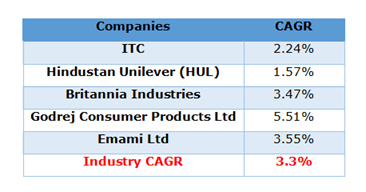
*Companies ranked based on FY2025 Revenue (highest – lowest)
Despite these challenges, structural drives such as digital retail penetration, improving rural infrastructure, and the expansion of new-age D2C brands like Honasa Consumer Ltd signal long-term resilience. Traditional leaders like HUL, ITC, and Britannia face pressure to innovate and reprice portfolios amid evolving consumption patterns. Government measures, including GST rationalization, make in India, and PLI incentives, continue to play a supportive role by improving supply chain efficiency and enhancing competitiveness. The sector’s future growth will depend on effective inflation control, cost management, and strategic innovation to capture emerging demand in Tier-2 and rural markets.
Looking ahead, the Indian FMCG industry is expected to stabilize and grow at around 4% CAGR between 2026 and 2029, assuming moderation in input costs and sustained recovery in discretionary spending. This trajectory reflects a shift from rapid expansion to sustainable, value-driven growth, consolidating India’s position as a major FMCG hub serving both domestic and export markets.
Here is a quick overview of key players in the industry.
Hindustan Unilever (HUL)
Hindustan Unilever Ltd (HUL) is a manufacturer and marketer of home care, beauty and personal care, and foods and refreshment products across India’s FMCG market. The company’s portfolio spans soaps, detergents, shampoos, skincare, oral care, tea, coffee, ice cream, and packaged foods, marketed under brands such as Surf Excel, Dove, Lux, Lifebuoy, Pepsodent, Sunsilk, Lakmé, Brooke Bond, Bru, and Kwality Wall’s. HUL sells through distributors, retail outlets, and e-commerce, operates manufacturing facilities across India, and is headquartered in Mumbai, Maharashtra, India.
Colgate-Palmolive (India) Ltd
Colgate-Palmolive (India) Ltd is a leading manufacturer and marketer of oral care and personal hygiene products. The company’s product portfolio includes toothpaste, toothbrushes, mouthwash, and personal care items sold under brands such as Colgate and Palmolive. It markets its products across India through a strong distribution network encompassing traditional trade, modern retail, and e-commerce channels. Colgate-Palmolive (India) operates manufacturing units in multiple states and is headquartered in Mumbai, Maharashtra, India.
Godrej Consumer Products Ltd (GCPL)
Godrej Consumer Products Ltd (GCPL) is a major Indian FMCG company engaged in the manufacture and marketing of personal care, home care, and hair care products. The company’s portfolio includes soaps, hair colorants, household insecticides, and air care products marketed under brands such as Cinthol, Godrej Expert, Good Knight, Hit, and Aer. GCPL operates manufacturing facilities across India and has a strong international presence in Asia, Africa, and Latin America. The company is headquartered in Mumbai, Maharashtra, India.
Honasa Consumer Ltd
Honasa Consumer Ltd is an Indian personal care company known for its digital-first approach and purpose-driven brands. The company’s portfolio includes skincare, haircare, and baby care products marketed under brands such as Mamaearth, The Derma Co, Aqualogica, and BBlunt. Honasa distributes its products through e-commerce platforms, modern retail, and direct-to-consumer channels. The company operates manufacturing facilities across India and is headquartered in Gurugram, Haryana, India.
Dabur India Ltd
Dabur India Ltd is a leading Indian fast-moving consumer goods company with a portfolio spanning healthcare, personal care, home care, and foods and beverages. Its offerings include ayurvedic health supplements, hair care, oral care, skincare, and beverages sold across India and international markets through established retail and distribution networks. The company operates manufacturing facilities in India to serve domestic demand and exports and is headquartered in Ghaziabad, Uttar Pradesh, India.
.
Industry Performance
India’s FMCG industry remains a pivotal growth driver, with household and personal care continuing to contribute about 50% of sector sales and the category mix broadly unchanged in 2025. After the inflation-led volume squeeze in FY2022, sector momentum has improved: Market research reports Q2 FY26 FMCG value growth of 13.9% with 6% volume growth, led by rural India’s 8.4% volume rise versus 4.6% in urban markets, while unit growth and smaller packs supported offtake. Recent trackers indicate a steadier operating backdrop as input-cost pressures ease; the sector is growing steadily into FY26, aided by rural-led demand, lower input costs, and softer food inflation, though margins remain a watch-item in select commodities. Overall, the industry’s expansion is underpinned by rising disposable incomes, youth demographics, and widening digital and distribution reach, with official industry briefs maintaining FMCG’s status as one of India’s largest sectors by GDP contribution and employment…
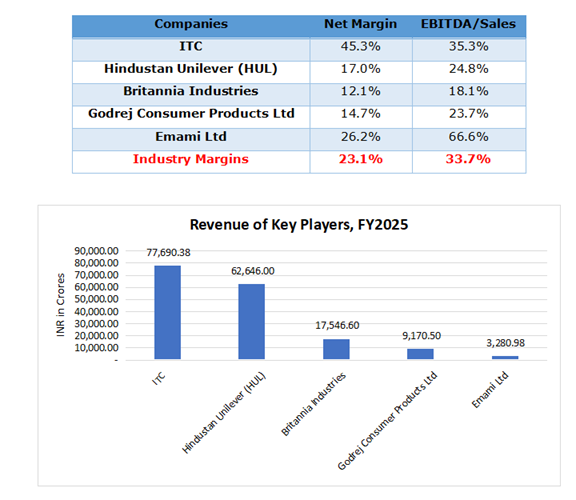
The performances of key companies in the industry give indications that the top 5 companies having high market share. The reported margin of the industry by analyzing the key players was around 23.1% by taking into consideration the last 3 years’ data. Details are as follows.
Industry Trends
India’s fast-moving consumer goods (FMCG) sector is transforming rapidly amid evolving consumer preferences, digital disruption, and demographic shifts. Valued at $220 billion by 2025 with 14–15% annual growth, it is driven by rural demand recovery, digital penetration, and changing consumption habits. Companies are balancing affordability with premiumization while integrating sustainability and technology to stay competitive. The winners will be those who blend innovation, inclusivity, and agility across diverse consumer segments.
- Rural demand outpaces urban: Rural India has grown faster than cities for six straight quarters, with Q2 FY26 rural volumes up 8.4% versus 4.6% in urban, establishing the countryside as the primary engine of FMCG growth. Market briefs highlight rural’s expanding contribution to category volumes as firms push smaller pack sizes, deepen distribution beyond Tier-3, and align pricing to local purchasing power.
- Digital and e-commerce acceleration: E-commerce and quick commerce are taking a larger share of FMCG sales, with metros and southern markets leading online penetration as companies scale omnichannel, D2C pilots, and precision pricing powered by analytics and AI. Despite a modest overall share, online channels now contribute a disproportionate slice of incremental growth and are embedded in FY26 go-to-market plans, per sector quarterlies.
- Premiumization and health focus: Households are trading up within staples, beverages, and personal care, with leading brands growing by delivering consumer-centric innovation and premium propositions that raise repeat rates and Consumer Reach Points. Industry outlooks further note a sustained shift toward nutrition, hygiene, and performance benefits as disposable incomes and awareness rise across core cohorts.
- Sustainability and packaging transformation: ESG and circularity are reshaping product and pack design, with companies advancing plastic-neutrality, recyclable mono-materials, and lightweight formats that lower logistics cost while meeting compliance and safety standards. Policy tailwinds and enterprise commitments are moving sustainable packaging from pilot to scale in FY25–26 roadmaps.
- Rise of small and regional players: Momentum has tilted toward smaller manufacturers and regional brands, which are capturing share on agility, local relevance, and competitive pricing, especially in rural and semi-urban catchments. Quarterly sector reviews flag this shift as a durable competitive dynamic that incumbents are addressing via portfolio localization and selective partnerships or acquisitions.
DART Consulting provides business consulting through its network of Independent Consultants. Our services include preparing business plans, market research, CFO Services, AI Consulting, and providing similar business advisory services. More details at https://www.dartconsulting.co.in/dart-consultants.html