
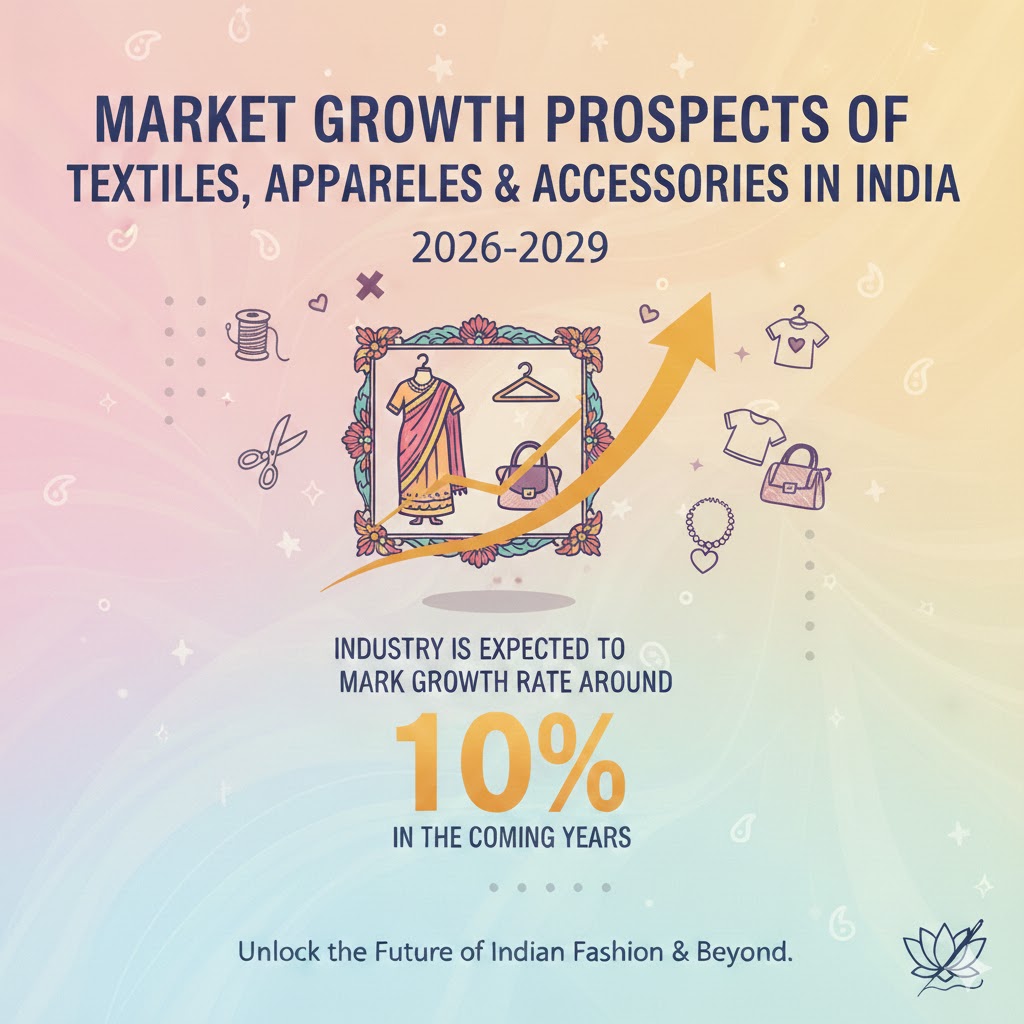
The Indian textile and apparel industry is a cornerstone of the nation’s economy, encompassing the entire value chain from fiber to fashion. In FY 2024–25, the sector contributed approximately 2.3% to India’s GDP, 13% to industrial production, and 12% to total export earnings, underscoring its economic significance. The industry is projected to reach USD 350 billion by 2030, driven by rising domestic consumption and global demand for sustainable textiles. Government initiatives like the Production Linked Incentive (PLI) Scheme and the PM Mega Integrated Textile Region and Apparel (PM MITRA) Parks are boosting manufacturing competitiveness, while digitalization and e-commerce platforms are transforming retail and export opportunities.
We, DART Analysts, based on data up to 2022, reported that the Indian Textiles and Apparel Industry had achieved an overall Compound Annual Growth Rate (CAGR) of around 11%, with projections indicating steady expansion during the period 2023–2027. The earlier analysis highlighted growth driven by rising domestic consumption, export demand, government incentives such as PLI and PM MITRA, and increasing adoption of sustainable and technical textiles. However, the updated analysis (as of 2025) shows a moderation in growth momentum, with the industry CAGR averaging 10.0% over the period 2022–2025. This slowdown is attributed to global demand softness, rising raw material costs (especially cotton), supply chain disruptions, and margin pressures from intense competition and shifting consumer preferences. Nonetheless, the sector remains resilient, supported by government initiatives, increasing adoption of sustainable and technical textiles, digital integration in manufacturing, and growing export diversification, positioning it for sustainable and inclusive growth in the coming years.
| Companies | CAGR |
| Welspun Living | 4.49% |
| KPR Mill | 9.59% |
| Page Industries | 8.54% |
| Pearl Global Industries Ltd | 18.23% |
| Garware Tech. | 9.11% |
| Industry CAGR Average | 10.0% |
*Companies ranked based on FY2025 Revenue (highest – lowest)
The performance trend suggests that while the Indian Textiles and Apparel Industry remain structurally strong, growth has transitioned from a phase of rapid expansion to one of stabilization and consolidation. Companies are increasingly focusing on enhancing operational efficiency, optimizing supply chains, adopting sustainable production methods, and diversifying product portfolios to maintain competitiveness in both domestic and international markets. The sector has experienced pressure from volatile raw material prices, subdued global demand, and rising production costs, which have collectively moderated profitability and growth momentum in the short term.
Looking ahead, the Indian Textiles and Apparel sector is expected to stabilize and grow at a CAGR of around 10% between 2026 and 2029, slightly below the pace of its top-performing firms. This outlook is supported by rising domestic consumption, export diversification, government initiatives such as the PLI Scheme and PM MITRA Parks, and increased investment in automation and technical textiles. The industry’s evolving direction reflects a strategic transition from volume-led production to value-driven growth, emphasizing innovation, sustainability, and digital transformation, positioning India as a global leader in textile manufacturing and apparel exports in the coming decade.
Here is a quick overview of key players in the industry.
Page Industries Ltd.
Page Industries Ltd., the exclusive licensee of Jockey International Inc. (USA) for India, Sri Lanka, Bangladesh, Nepal, and the UAE, is a leading player in the innerwear, leisurewear, and sportswear segment. The company has established a strong retail and distribution network with a significant presence across multi-brand outlets, large format stores, and exclusive brand outlets (EBOs). Page Industries continues to focus on brand-driven growth, premiumization, and operational efficiency, while investing in technology and automation to enhance productivity. Its strong brand equity and consistent innovation in product design have positioned it as one of the most profitable apparel companies in India.
Garware Technical Fibres Ltd.
Garware Technical Fibres Ltd. is a global leader in technical textiles, specializing in solutions for fisheries, aquaculture, agriculture, sports, infrastructure, and defense applications. The company focuses on developing high-performance products through R&D-driven innovation and material engineering. With a strong export footprint in over 75 countries, Garware continues to leverage sustainability, product customization, and operational excellence to strengthen its global competitiveness. Its focus on margin improvement and high-value product segments has contributed to steady financial growth and resilience against market volatility.
KPR Mill Ltd.
KPR Mill Ltd. is one of India’s largest vertically integrated textile manufacturing companies, with capabilities spanning yarn, fabric, garments, and sugar & ethanol production. The company operates advanced manufacturing facilities supported by automation and sustainable practices such as renewable energy usage and eco-friendly processing. KPR Mill’s robust export base, coupled with a focus on value-added products, efficiency, and workforce welfare, has made it a preferred partner for global apparel brands. It continues to invest in capacity expansion and digital transformation to sustain growth momentum and enhance profitability.
Pearl Global Industries Ltd.
Pearl Global Industries Ltd. is a global apparel manufacturing and export company, providing end-to-end supply chain solutions from design and product development to manufacturing and distribution. With operations across India, Bangladesh, Indonesia, and Vietnam, the company caters to leading international fashion and retail brands. Pearl Global focuses on sustainability, ethical manufacturing, and automation, integrating technology to enhance speed-to-market and product quality. Its strong global presence and diversified customer base have supported double-digit growth, making it a key contributor to India’s apparel export ecosystem.
Welspun Living Ltd.
Welspun Living Ltd., part of the Welspun Group, is among the world’s leading home textile manufacturers, offering products such as towels, bed linen, rugs, and flooring solutions. The company serves top global retailers and has a presence in over 50 countries, including the US, UK, and Europe. Welspun Living emphasizes innovation, sustainability, and traceability through its patented technologies and ESG initiatives. Its strategic investments in brand development (e.g., Welspun, Spaces, Christy) and advanced manufacturing have reinforced its position as a trusted global textile brand. The company continues to focus on premiumization, digitalization, and design-led growth to strengthen margins and global market share.
Industry Performance
The Indian Textiles and Apparel Industry continue to be a cornerstone of India’s manufacturing and export economy, contributing significantly to GDP, employment generation, and foreign exchange earnings. It is driven by a strong domestic consumption base, expanding export markets, and growing investments in modern manufacturing and sustainable production. Over the past few years, the industry has demonstrated resilience amid global demand fluctuations, supported by government initiatives such as the PLI Scheme, PM MITRA Parks, and incentives promoting technical and sustainable textiles. Today, India is focusing on enhancing value addition, boosting exports, and integrating advanced technologies across the textile value chain from fiber to fashion. By embracing innovation, automation, and eco-friendly manufacturing practices, the industry aims to strengthen its global competitiveness and establish itself as one of the most dynamic and sustainable textile and apparel markets in the world.
The performances of key companies in the industry give indications that the industry is profit-making and would be growing in the coming years. The reported margin of the key players was around 10.6%, taking into consideration the data for the last 3 years’ data. Details are as follows.
| Companies | Net Margin | EBITDA/Sales |
| Welspun Living | 6.0% | 13.6% |
| KPR Mill | 12.6% | 20.4% |
| Page Industries | 14.6% | 22.5% |
| Pearl Global Industries Ltd | 5.1% | 9.7% |
| Garware Tech. | 14.7% | 11.3% |
| Industry Margins | 10.6% | 15.5% |
Industry Trends
The Indian textile and apparel industry is undergoing a major transformation, driven by policy support, global market shifts, and technological upgrades. Strategic government initiatives and evolving trade dynamics are positioning India as a leading global hub for textile manufacturing. Key recent developments include:
- The PLI Scheme has catalyzed investments of ₹7,343 crore, leading to a turnover of ₹4,648 crore and exports worth ₹538 crore. This initiative aims to boost the production of man-made fiber (MMF) apparel, MMF fabrics, and technical textiles, enhancing India’s competitiveness in the global market.
- The government has approved the establishment of seven PM MITRA Parks with an investment of ₹4,445 crore. These parks are designed to provide world-class infrastructure, including plug-and-play facilities, to attract investment and generate employment in the textile sector.
- Launched by the Ministry of Textiles, the Swadeshi Campaign aims to enhance domestic demand for Indian handlooms, handicrafts, and textile products. The campaign targets urban youth and Gen Z, promoting indigenous products and projecting the domestic textile market to reach $250 billion by 2030.
- India’s textile industry, particularly in regions like Tirupur, is transitioning towards MMF to meet global demand. This shift is driven by strategies like “China Plus One,” aiming to diversify supply chains and reduce dependency on cotton. The move is expected to double the turnover of MMF production in these regions by 2030.
- In response to increased U.S. tariffs, Indian textile exporters are focusing on diversifying their markets. The European Union has become a priority, with trade negotiations underway to boost exports. This strategic shift aims to mitigate risks associated with over-reliance on the U.S. market.
DART Consulting provides business consulting through its network of Independent Consultants. Our services include preparing business plans, market research, and providing business advisory services. More details at https://www.dartconsulting.